How AI can move us towards a circular textile economy
Textiles are a fundamental part of everyday life and a pillar of the global economy. Where would we be without textiles and the many fabrics we make from them? Clothes are worn by everyone almost all the time and are for many an important way to express themselves. A world without clothing would be like a body without a heart.
Driven by a growing middle class and the fashion phenomenon fast fashion in Western countries, the world’s total volume of manufactured clothing has more than doubled since the turn of the millennium. While a growing middle class is obviously to be desired and should not be blamed for problematic developments within the consumer sphere, fast fashion very much calls for closer inspection.
Fast fashion
Fast fashion is the term used for low-priced, trendy clothing, which by dint of rapidly changing fashion trends is worn very few times before being retired at the bottom of the dresser or disposed of entirely. Globally, a piece of clothing or footwear is worn an average of 120 times before it is substituted for a new one, but in the Western world that number is far lower. A 2015 British consumer survey revealed that the average woman in the UK wears a piece of clothing as few as seven times before losing interest in it.
A parallel problem is that the clothing industry’s manufacturing technologies have developed significantly slower than its design and marketing capabilities. Fast fashion arose by dint of shortened fashion cycles and lower prices — engendered by almost all production being moved to third-world countries — but similar innovation has not gained ground within the methods of production, which remain low-tech, inefficient and heavily polluting. As a result, fast fashion today stands as a business model with a modern framework for customer appeal and sales, but with an underdeveloped production anatomy. Demand is essentially maximised, but supply can meet it only by means of utilisation and preservation of deeply problematic manufacturing processes.
Recycling is just a word
Of all materials used in the manufacture of clothing, less than 1% of them are reused in a second manufacturing cycle, leading to an annual value loss of more than $100 billion. Add to this direct waste, then, the expenses incurred when disposing of clothing and household textile waste in landfills. In the UK alone, where more than 300,000 tonnes of clothing are thrown out annually, more than $100 million is lost through this practice. The USA, Canada and Mexico combined are estimated to throw out 11 million tonnes of clothing. 150 billion new pieces of clothing are marketed every year, of which 25% are never used and simply destroyed when not sold.
Across the textile industry, 13% of the materials used are recycled in one way or another, but almost all of this recycling consists of input flows to other industries or reuse in less valuable fabric products such as insulation material, mattress filling and the like. What these have in common is their low degree of recyclability, which in almost all cases limits their reuse to a single cycle. Although some Western countries have high collection rates for recycling, large percentages of these fabrics are exported to countries without equivalent recycling frameworks, which likewise limits fabric reuse to rarely more than 1–2 cycles. Adding together the loss of material value due to a lack of recycling and the built-in cost of underutilisation, the total loss of value is estimated to amount to a staggering $500 billion, or 0.5% of the world’s GDP.
The linear problem
Problematic facts abound: The textile industry depends on fossil fuels — 100 million tonnes annually — for the manufacture of synthetic fibres, cotton fertiliser and chemicals for the manufacture and dyeing of fibres and textiles. Two thirds of all clothing is of fossil origin, 1.2 billion tonnes of CO2e are emitted annually — more than the airline and shipping industries combined — 50 million tonnes of chemicals are used throughout the supply chain, and 100 billion cubic metres of water are consumed. Add to these facts that the industry emits 20% of the world's industrial wastewater, that workers are often subjected to highly objectionable working conditions, and that global sales and production numbers are expected to triple before the year 2050, and the problems should be clear as day: Consumers’ underutilisation, a low recycling rate and the massive consumption of raw materials in manufacturing comprise a wasteful, linear system that puts enormous pressure on the world’s natural resources and contributes heavily to global warming.
In this huge, global machinery, ID UNLIMITED is of course but a small cog with a correspondingly small influence, but part of operating as a responsible company — meeting ethical laws, rules and standards affecting society, customers and employees — is not hiding behind others regardless of one’s relative size. To the contrary, it is acknowledging that all companies in essence take part in a prisoners’ dilemma game, in which selfishness is tempting but the best holistic results actually are achieved through cooperation. That is the point of view from which we endeavour to make ID UNLIMITED’s economy 100% circular.
Resources or stakeholders
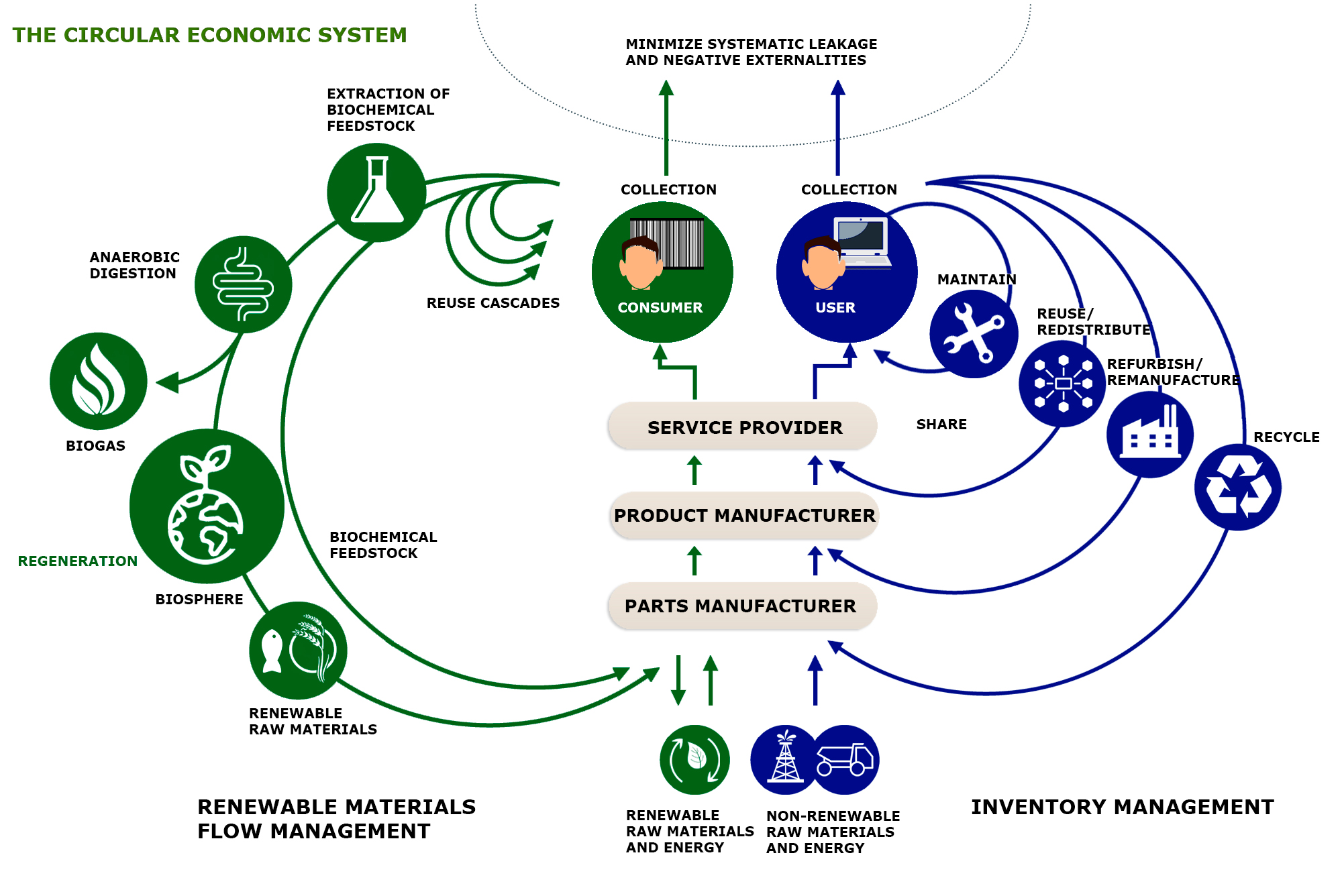
A ‘circular economy’ denotes an organised economic development which favours not just companies but their surrounding societies and environments as well. It does so by being organically regenerative and gradually seeking to separate financial growth from consumption of limited resources. The circularity is seen in a value chain’s ability and tendency to convert waste products into new products, instead of disposing of them without realising their recycling potential.
The circular economic development has a background in the theory that companies fundamentally depend on at least one of two possible ‘domains’, resources or stakeholders, and that they through their actions choose between them. Historically, avaricious and amoral resource consumption has been the business world’s primary source of growth. Such an approach pursues a linear ‘procure-manufacture-discard’ system with maximum growth and minimal regard for anything else. Stakeholders’ expectations and demands of behaviour and ethics are repressed or neutralised, and only shareholders’ desire for continuous profits and growth influences managerial decision-making.
The growing consciousness about nature and the fundamental worth of the individual have over the last decades, however, effected a paradigm shift under which the business world to a greater extent is pressured into accommodating stakeholder expectations and demands of sustainability and respect for human rights. Everyone has realised that consumers can choose to not do business with companies they dislike and consequently can influence managerial decision-making even more than shareholders can. Today, the moment a company signals its disregard for consumer expectations, it is rejected in favour of more accommodating competitors.
The circular solution
It is estimated that reshaping the textile industry from a linear to a circular economy would prevent an annual global loss of $500 billion. The realisation of this requires innovation and cooperation across the industry’s segments — from manufacturing through marketing to consumer habits. The segments should, to the greatest extent possible, meet six different, yet connected, criteria:
1. Clothing is designed and manufactured to reflect the individual’s personal style. It is easily accessible, durable and affordable.
2. Clothing is used until physically worn out. When disposed of, it is recycled to the greatest possible extent.
3. Manufacturing processes run on sustainable energy, and production inputs are based on sustainable resources.
4. Clothing prices reflect the true environmental and societal costs associated with its manufacture.
5. Manufacturing processes regenerate nature’s sustainability and do not pollute the environment.
6. Companies operate with an eye towards strengthening social cohesion. Business partners and employees receive compensation which enables participation in the wider economy.
While ID UNLIMITED neither manufactures nor sells clothing, and therefore escapes much of the criticism aimed at the textile industry, we nonetheless manufacture textile products employing colours and other chemical inputs with the potential for harming people and the environment. For this reason, we look at the above six criteria with great interest and consider how they can guide and inspire us to keep our own house in order. Not all indicated or suggested solutions are relevant to a supplier of fabric embellishments like us, but some are, and these we let guide and inspire us.
We prioritise custom printing and fabric longevity by letting our customers design unique, personal applications with a resilience matching the clothing on which they are printed. A product co-manufactured by consumers themselves is valued more and preserved better over time. Strong durability further enables resale options after the product is no longer wanted by its initial designer.
Wind power is a sustainable source of energy that causes less environmental damage than many others. Electricity-producing wind turbines do not cause polluting emissions of CO2 or require water for cooling. While fossil fuels are often used in their manufacture and/or transportation, and wind turbines therefore cannot be said to be 100% environmentally friendly, wind power is nevertheless far more sustainable than coal, oil and natural gas power — which still accounts for 84% of the world’s energy consumption. At ID UNLIMITED, sustainable and CO2-neutral wind power comprises 100% of our electricity purchases.
Fair compensation and minimal pollution are among our core values. We are Global Organic Textile Standard-certified, having the world’s leading textile standard’s guarantee that our employees are compensated in accordance with Denmark’s broader price levels and that waste products, chemicals and wastewater are managed responsibly. One area in which we still have room for improvement is in our products’ price setting. Our most environmentally friendly products are generally more expensive than our less environmentally friendly products, by dint of which we still don’t — as recommended in the fourth of the above listed criteria — price our products in line with their true environmental and societal impact.
Artificial intelligence
A vital part of a successful transformation from a linear economy to a circular is the recycling of products and materials, optimisation of business models and elimination of waste and pollution. To this end, artificial intelligence is viewed by many as a handy pathfinder, so let’s here take a closer look at what AI is and how it can help us towards our stated goal.
What is artificial intelligence?
Artificial intelligence is a broad category of technology under which lifeless objects are autonomous, intelligent and productive. It describes a systematic accumulation of knowledge about how computer programs and systems learn to perform sapient activities such as logical thinking and knowledge acquisition. Central to AI, and what separates it from standard software, is its ability to learn from experience, i.e. forming new, self-generated behaviour patterns on the basis of registered data points in the form of images, video, text, sound or numbers. In the business world — especially manufacturing — easily definable and targeted tasks such as route planning or song recommendation are typically aided by AI. Software so limited in scope and objectives is called ‘narrow AI’. Narrow AI is contrasted by the far more complex, ambitious and human-like ‘general AI’.
How can artificial intelligence advance the circular economy?
Artificial intelligence can create, support and optimise the regenerative business models central to the circular economy. Among the technology’s largest focus areas is design optimisation, a domain viewed as having a high profit potential. Based on large amounts of data, AI can suggest new designs or adjust existing ones, after which a human designer can review and implement them to the extent that they are innovative and useful.
Development of AI can never be achieved by software alone but requires comprehensive cooperation with humans. A computer program needs external frames and reference points to develop new behaviour patterns. It does not, e.g., possess innate knowledge of how a game of chess is won but depends on first being instructed by humans about the importance of protecting the king, the queen’s importance over that of the pawn, that the bishop can only move diagonally etc. Only after determining such fundamental rules and objectives can the program begin developing and testing new and improved patterns of behaviour.
AI can advance a circular textile economy by e.g. developing algorithms for improved inventory management and logistics, more efficient use of fabrics and chemicals, quicker design processes and better machinery maintenance. Set habits and opinions within these areas, which often can be difficult for humans to let go of, can be easily set aside by artificial intelligence, whose innovativeness can lead to meaningful improvements and stronger efficiencies. Cameras and other sensors can be used to identify products and manufacturing components, and the collected data points subsequently employed by the software to e.g. locate and remove defective products or change designs towards preservation of input resources.
Intelligent software already exists in a long line of industries in which it mostly just needs to be used in more circular contexts. The textile industry, however, still has much unexplored potential vis-à-vis AI, needing companies to take on a different mindset and become more willing to try new things. AI doubtless has the potential to alleviate many of the textile industry’s shortcomings. All we need to do to realise it is to cooperate — with our computers as well as our stakeholders.