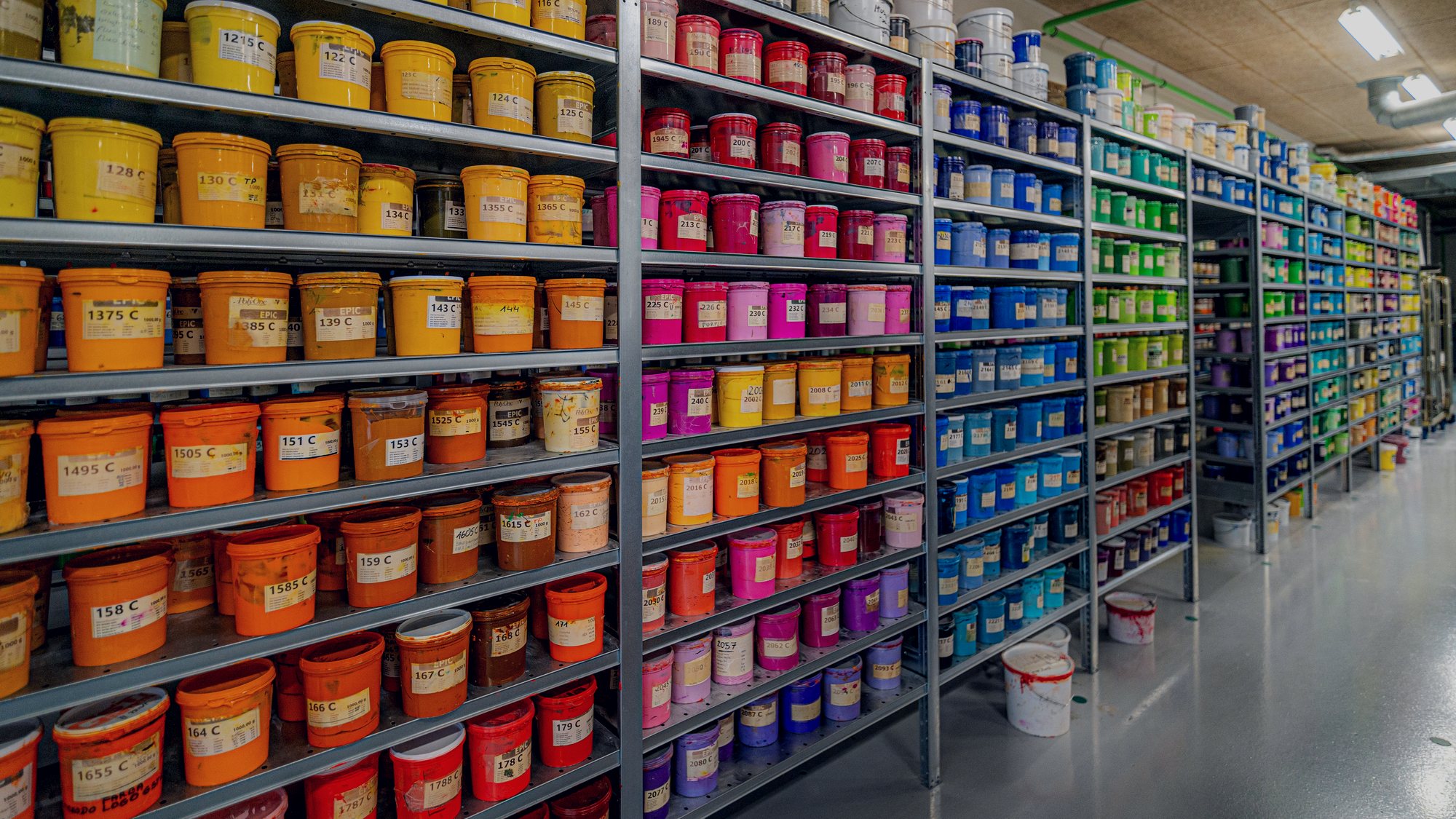
In screen printing, ink is pressed through a fine mesh and down onto the textile. The mesh is stretched over a wooden or metal frame and fitted with what is known as a stencil (screen), which forms the motif to be printed. The ink is spread evenly across the whole frame with a squeegee and pressed through the mesh over the areas of the substrate not covered by the stencil. The resulting outline forms the finished print.
Screen printing has the best possible durability and stretch of all prints, because the ink is printed into the fabric itself. The durability and stretch the fabric already has are therefore unaffected by the print. This property makes the method well suited to the food industry, among others, where for hygiene reasons prints must not come off or rub off.
Screen printing is comparatively less effective at reproducing very small details such as colour gradients, i.e. gradual transitions between two or more colours. If a very lifelike reproduction is wanted, for example a face, screen printing should, all else being equal, not be the preferred printing method. In such cases we recommend our Digital transfer instead, which handles colour gradients excellently. Screen printing, on the other hand, excels at reproducing simpler graphic elements, as these take less time to make screens for and are easier to colour.
How heavy the screen print becomes depends on how many colours are used: the more colours, the heavier the print. The screen print will, however, always be thinner and lighter than the heat transfer, where the ink is not absorbed but deposited on the surface.
The opacity of the screen print is generally poorer than that of the heat transfer, since the fibres sometimes rise during printing and give a less distinct result. As this largely depends on the individual fabric's fibres and their particular response to application, it is not always the case, however. We assess from job to job whether the expected opacity will meet your expectations, and advise accordingly.
When the underlying (receiving) textile is changed between prints, a slight difference between the individual prints can occur. If the textile is not changed, however, screen printing delivers a consistency that is good enough for almost any purpose.
Screen printing takes a relatively long time to set up and is therefore used primarily for large orders. It is rarely cost-effective to print a small handful of t-shirts when it has taken several hours to make the corresponding screens.
Screen printing is done with water-based ink as standard, but can also be done with plastisol ink on request. Plastisol is, all else being equal, the more economical solution, while water-based is the more sustainable.
As each individual colour can only be applied separately, screen printing is typically used for designs with few colours. At ID UNLIMITED we allow up to 8 colours in a design before another printing method is required.